SPU NL 
Hand Auger "HDT-5"
The most powerful and durable in its class

(delivery anywhere in the world)
Home Place an order
Contacts Delivery
рисунок Россия

Equipment selection

рисунок
рисунок Video Catalog
All the equipment is fully standardized; this means that the rods and other elements from all sections are compatible with each other.
Configuration data for the HDT-5 hand auger Underreamer (Widener)
Equipment Price, $ (€)
Underreamer (Widener) 113.34 (100.00)

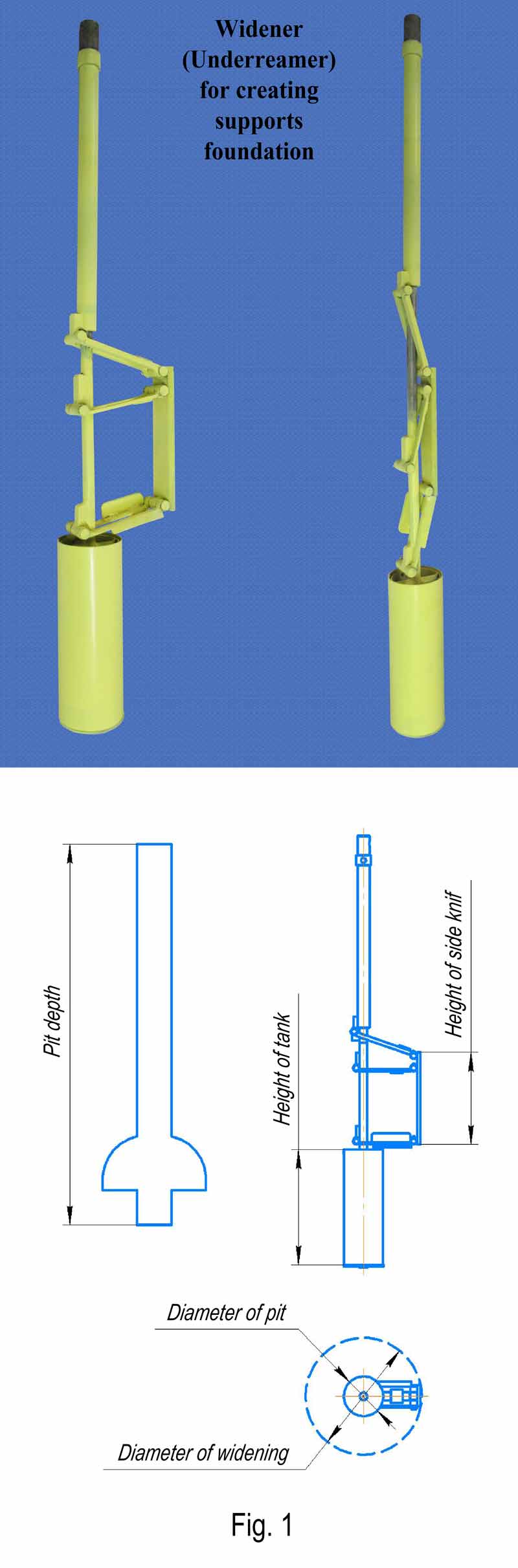
Parameter selection (see Fig. 1)

 When ordering, you must specify 4 parameters of the underreamer or accept the default values.

 1. Borehole diameter.

 2. Underream diameter.

 3. Side blade height.

 4. Soil bucket height.

 1. Borehole diameter.
The minimum value is 10 cm. The maximum value is 40 cm (limited by design). Recommended values are 10, 20, and 30 cm. If you select intermediate values, a custom-made auger will be required.

 2. Underream diameter.
The minimum underream diameter is equal to the borehole diameter + 5 cm. The maximum underream diameter is equal to three borehole diameters. Production outside of this range is available upon agreement.

 3. Side blade height.
The minimum height is 5 cm (limited by design). The maximum height is 20 cm. Blades taller than 20 cm can be manufactured upon request.

 4. Soil bucket height.
The minimum height is 10 cm (limited due to the need for centering the underreamer). The maximum height is 50 cm. A bucket with a height-to-diameter ratio greater than 3 may be difficult to clean from soil. Buckets taller than 50 cm are available upon request.

 You can also specify the planned borehole depth. This is an optional reference dimension. If specified, the order page will display the following values in addition to the underreamer parameters:
 total borehole volume,
 concrete volume (total borehole volume minus the volume under the soil bucket),
 volume of the cylindrical part,
 underream volume.
 This data is necessary to calculate the required volume of concrete mix and the amount of work when building the foundation.

The underreamer parameters can be configured in the corresponding section on the order page.

Justification of the use of the underreamer and preliminary calculation of the scope of work

 This section is quite extensive, but we have tried to share all available knowledge on the matter. Since this information is unique, any similar data found elsewhere will most likely be copied from this page.

 Since our company’s inception, we have received requests to manufacture an underreamer for foundations. Initially, we were extremely skeptical about the idea of widening the bottom of a borehole. We proceeded based on the following concerns: first, it is difficult to compact the underream, which could reduce the bearing capacity of the pile; second, the arch of the underream might be unstable and prone to collapse (later, after drilling actual boreholes with underreams, these concerns disappeared, as discussed below). The load-bearing capacity calculations for the piles are based on the official Russian Building Codes (SNiP), which can be found in the technical information section on the Russian version of our website.

 Nevertheless, many years later, we returned to this topic due to persistent requests from our equipment owners. To provide a technical justification for developing the underreamer, we shifted our focus. Instead of evaluating the bearing capacity of an individual pile, as we did previously, we calculated the total volume of excavation work required to install a house foundation.

 The results were impressive. For the calculations, we used the formulas from the same Russian Building Codes (SNiP) document mentioned above. The calculation model was heavily simplified, and the input values were adjusted toward reducing the assumed bearing capacity of the soil and the pile itself. This makes the calculation applicable as a preliminary assessment for the vast majority of soils, except for permafrost or highly unstable ground (swamps, quicksand, etc.). Additionally, this calculation cannot be applied to complex terrain (slopes, nearby ravines, etc.).

 Calculation:

 Fd = (Yc⋅R⋅A)/10 – bearing capacity of the pile in tons

 where:
 Yc - is the dimensionless coefficient of the pile's working conditions.
A value of 0.8 was adopted, corresponding to the most challenging working conditions in silty clay soils with a high moisture content and on loess soils.

 R - the design resistance of the soil under the lower end of the pile in kPa.

 А = π⋅(D/2)2 - the area of the bearing surface of the pile in m2. Where D - is the diameter of the bearing surface of the pile in m.

 The calculation is applicable for piles with a depth of 2.5–3 meters.

 The main parameter is R, the soil resistance. If the pile is installed on clean, moist clay, then R = 250 kPa. However, such soil is very rare; the overwhelming majority is loam with hard rock inclusions, so R = 600 kPa should be taken for preliminary calculations.

 For comparison, an ordinary wooden house with an area of 36 sq. m was chosen.
 The approximate weight of the house, taking into account the loads (snow + operational) and a safety factor of 1.3, is 80 tons.
 The specific density of concrete used to create the foundation is 2 t/m3.

 And now the most important part: Calculation of the required number of piles.

 To do this, divide the weight of the house by the bearing capacity of the pile and round it up to the nearest integer.

 The first case: a straight-shaft pile in a borehole with a diameter of 30 cm (0.3 m) and a depth of 2.5 meters.
 Pile volume: 0.177 m3, pile weight: 0.354 t.
 A = π⋅(0.3/2)2 = 0.071 m2.
 Fd = ((0.8⋅600⋅0.071)/10) - 0.354 = 3.054 t.
 Number of piles: 80 / 3.054 = 26.195 ≈ 27 piles.

 The second case: an underreamed pile. A borehole with a diameter of 20 cm (0.2 m), an underream of 60 cm (0.6 m) and a depth of 2.5 meters.
 Pile volume: 0.213 m3, pile weight: 0.426 t.
 A = π∙(0.6/2)2 = 0.283 m2.
 Fd = ((0.8⋅600⋅0.283)/10) - 0.426 = 13.158 t.
 Number of piles: 80 / 13.158 = 6.080 ≈ 7 piles.

 The results obtained clearly favor the use of underreamed bases. It is entirely possible to drill seven 20 cm diameter boreholes in a single day, whereas drilling twenty-seven 30 cm diameter boreholes is a highly labor-intensive task that could take a week. Even if we account for the fact that it might be necessary to drill eight boreholes with underreams instead of seven, this is still a single-shift job. This is achievable because drilling and underreaming are carried out in parallel, where two people drill and two people perform the underreaming. One additional borehole will be needed not because of the bearing capacity of the foundation, but to ensure that the spans between the supports under the wall do not exceed 3 meters, assuming that each wall of the 36 sq. m house is 6 meters long.

  Based on the new calculations, we decided to pursue this project. Initially, we did not want to go too deep into development, but simply intended to purchase existing devices from other manufacturers and weld our standard RBI-5A adapter to them. However, this idea quickly proved unviable. We purchased three devices from different manufacturers, as no others were available. After testing them, it became clear that this approach was completely unsuitable. To put it mildly, the operation speed was unacceptably slow. In addition, there was no possibility of scaling or flexibly changing parameters. Furthermore, their fundamental inability to work in a borehole with a diameter of 100 mm finally put an end to this idea.
 As a result, we had to develop our own device from scratch. A parallel-link blade mechanism was taken as a basis, which allows for flexible parameter adjustments tailored to specific tasks, fully aligning with our company's policy. The first working prototypes operate precisely within a minimum borehole diameter of 100 mm, which is technically the most challenging condition. Moreover, the devices themselves are essentially unparalleled.

 After drilling the boreholes with underreams, work was carried out to compact crushed stone at the bottom of these boreholes (in accordance with SNiP regulations). The findings were as follows: The central borehole has a tendency to compact easily, whereas the bearing surface formed by the underreamer resisted compaction, and driving crushed stone into it did not lead to noticeable results. Compaction was performed manually, using a 15 kg hand tamper as an impact tool. Tamping was performed until the sound changed from a dull, muffled thud to a characteristically sharper, ringing sound, which is typically obtained when striking a relatively hard surface. The test results can be explained as follows: The central borehole formed by the auger has a loose structure at the bottom and along the side walls. In addition, remnants of loose soil falling from the underreaming area are inevitable. In contrast, the surface formed by the underreamer is smooth and not loosened; upon impact, it immediately produces the same sound as the central borehole does only after thorough tamping. Naturally, with mechanized soil compaction, the efficiency would be higher. However, in practice, pouring crushed stone into the central borehole and working it with a manual tamper for a couple of minutes yields a result that is virtually indistinguishable from the mechanized method.

 By compacting the bottom of the experimental boreholes, our doubts were cleared on the two key points that originally made us hesitant to pursue this project. These were the compaction efficiency at the bottom of the borehole and the potential collapse of the underream ceiling. Based on the test results, we found that: first, the soil density at the bottom of an underreamed borehole is indistinguishable from that of a conventional borehole, and second, the ceilings of the underreams did not collapse during tamping. This does not mean that the ceilings will never collapse under any circumstances. However, there is no inherent tendency to collapse. Minor soil crumbling may occur, but it will not interfere with concreting.

 In conclusion, one important advantage of creating a foundation with a manual auger should be noted. This applies regardless of whether the drilling is carried out with or without underreaming.
 When constructing a foundation, excavation and actual concreting actions must be tightly coordinated. Having these tasks performed by a single organization is ideal; however, this option is often unavailable outside major cities. Typically, these services are provided by different enterprises: one company handles drilling and digging, while a concrete plant supplies the mixer truck. Ordering the mixer before the boreholes are ready is highly impractical, as any excavation delay will result in downtime costs for the concrete mixer. Conversely, if the mixer truck is called only after everything is ready, some boreholes will likely collapse before the machine arrives. Boreholes drilled mechanically are particularly prone to such collapse compared to those dug manually. Consequently, they will require clearing before concreting can begin. Restoring a collapsed borehole requires a drill or auger of the same diameter, which in turn can become another acute problem. If drilling and concrete pouring are performed in-house, such problems are eliminated in principle.

Scope of application

 The Underreamer (Widener) based on the RBI-5 hand auger is designed to create underreams in clay and sandy soils with hard rock inclusions up to 5 cm in diameter.

 The equipment can withstand a torque of up to 50 kgf·m (490 N·m) and a pulling force of up to 2 tons.

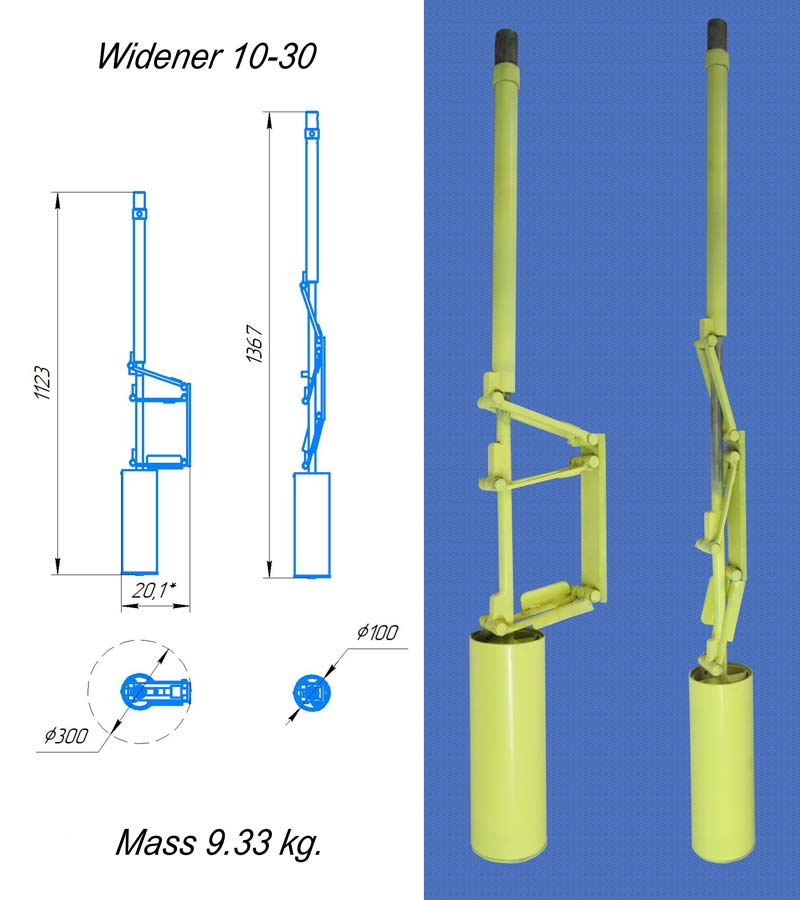
 Technical data, such as the weight and overall dimensions of the underreamer, will vary widely. In this regard, specific values will be provided for four or five basic products. The first number in the designation represents the initial borehole diameter, and the second number represents the underream diameter (in centimeters).

 1. Widener 10-30.

 2. Widener 20-60.

 3. Widener 30-90.

 4. Widener 40-113.

 5. Widener 40-120.

  Intended applications of the underreamers based on the model.

 The primary application of the basic Model 10-30 is the creation of lightweight foundations with a bearing capacity of 3–4 tons per pile*, as well as the installation of metal posts with concrete-filled bases. The posts can be installed at a shallow depth or even used for surface installation. Drilling to a shallow depth with a 30 cm auger is, of course, more convenient, but it does not offer the same versatility when installing posts. For instance, the underreamer can create custom intermediate diameters while forming a pre-centered recess for the post.

 Model 20-60. This model is expected to be highly sought after for residential foundation construction, offering a bearing capacity of 14–15 tons per pile*.

 Model 30-90. Designed for heavy-duty foundations, offering a bearing capacity of 32–35 tons per pile*.

 Model 40-113. Designed for extra heavy-duty foundations. This model is unique because it creates a pile with a bearing surface of 1 sq. m. The load-bearing capacity of such a support is 52–54 tons*. Additionally, this equipment can be used to drill large-diameter boreholes.

 Model 40-120. Designed for creating the largest possible underream using the RBI-5 hand auger. The load-bearing capacity of this support is 60–61 tons*. Additionally, this equipment can be used to drill large-diameter boreholes.

 *The load-bearing capacity values correspond to the calculations and conditions provided in the previous section.

Contacts for questions: configuration, application, delivery, etc.
Novaya Lyalya
Phone: +7 (34388) 2-27-62
Mobile: +7-967-852-42-01
Messengers:
Telegram
Yandex Messenger
MAX
npo-nl@npo-nl.ru


Weight and dimensions of drilling equipment
(all dimensions in the figures are in millimeters)

рисунок